Logis Network · subcontracting freight to partner carriers, inside the Inbox
Freight subcontracting usually runs on phone calls, forwarded emails and a rate nobody wrote down. On the Logis Network, handing a load to a partner carrier gets a transfer number both companies quote and one thread both companies read. Their driver’s status changes reach your trip as if he were yours. Your internal conversation never crosses. Your customer price never does.
Partners you invite work in a free workspace inside your network · The price both sides accept is the one on the record
A handoff (a transfer, TRF) is subcontracting one carriage from a Logis carrier to a partner carrier through the Logis Network. It carries the route, the cargo, the stop windows and an offered price. The partner accepts, counters or declines from their own Logis inbox — or from an email link if they are not on Logis yet. Once accepted, the price is the one both companies agreed, and the trip runs as one shared record with one shared thread.
Connect one partner during the trial — they pay nothing — and run the first handoff as a thread instead of a phone call.
Updated 5 Oct 2026 · Applies to Logis web and the Logis driver app · Available in English, German, French, Spanish, Dutch, Lithuanian, Polish and Russian
01 · The handoff thread
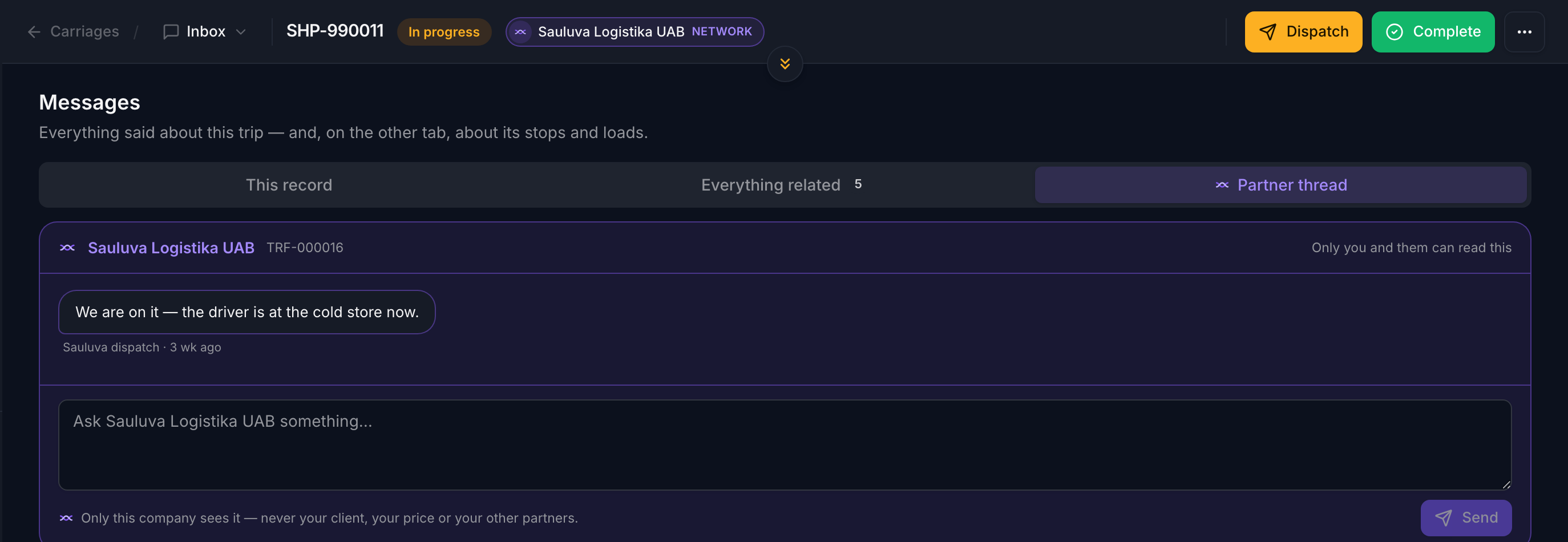
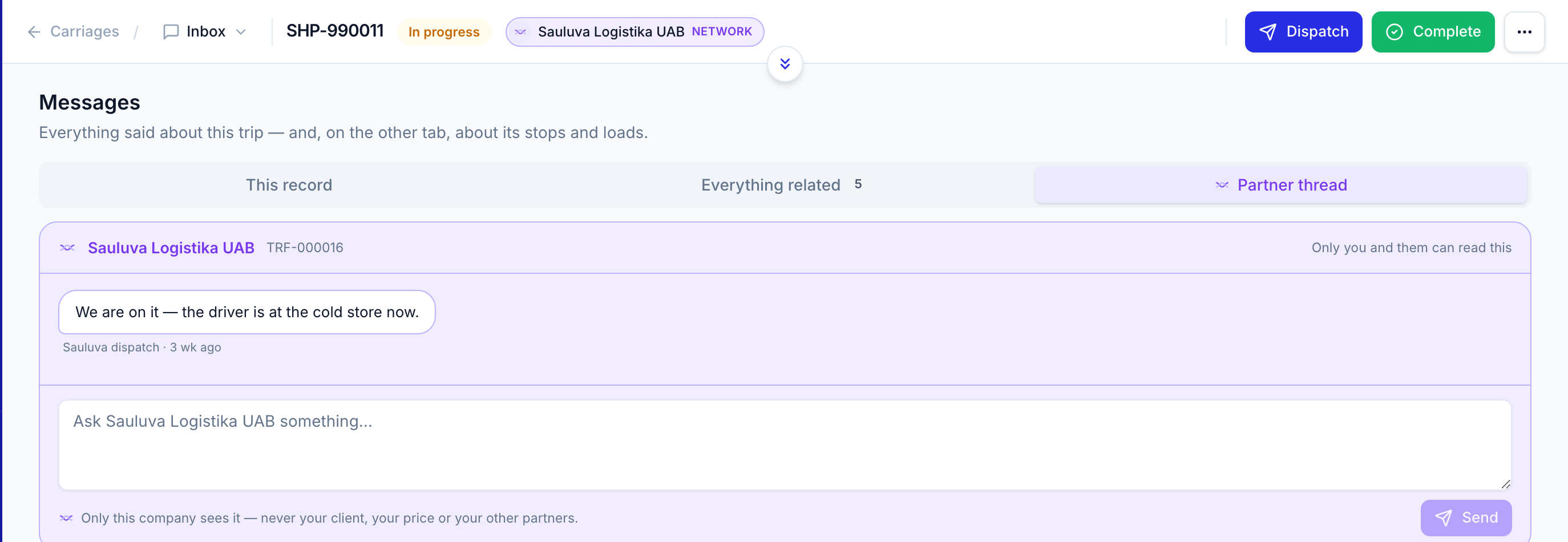
The thread’s header is the TRF — the one number both dispatchers quote — with the transfer’s state beside it and the people split by company. Everything written there is read by both companies. Your own discussion of the trip stays on your trip’s own thread, which never leaves your company. Documents you share cross; your price to your customer does not.
Who sees this thread
Baltijos Logistika · You
02 · Every transfer state, a card
A handoff moves through states the way a trip moves through stops. Each one arrives as a card where the dispatcher is already looking, coloured for what it asks: amber while it waits, violet when the partner speaks, green when a deal is agreed, blue when nobody owes an answer, red when the answer is no. The weave marks a fact that crossed a company boundary.
Sent
Waiting on the partner’s answer, with the offer open beside it
Counter-offer
Their price and their reason, in the thread
Accepted
Who accepted, when, and the agreed terms
No answer · moved on
03 · Accept, counter, decline
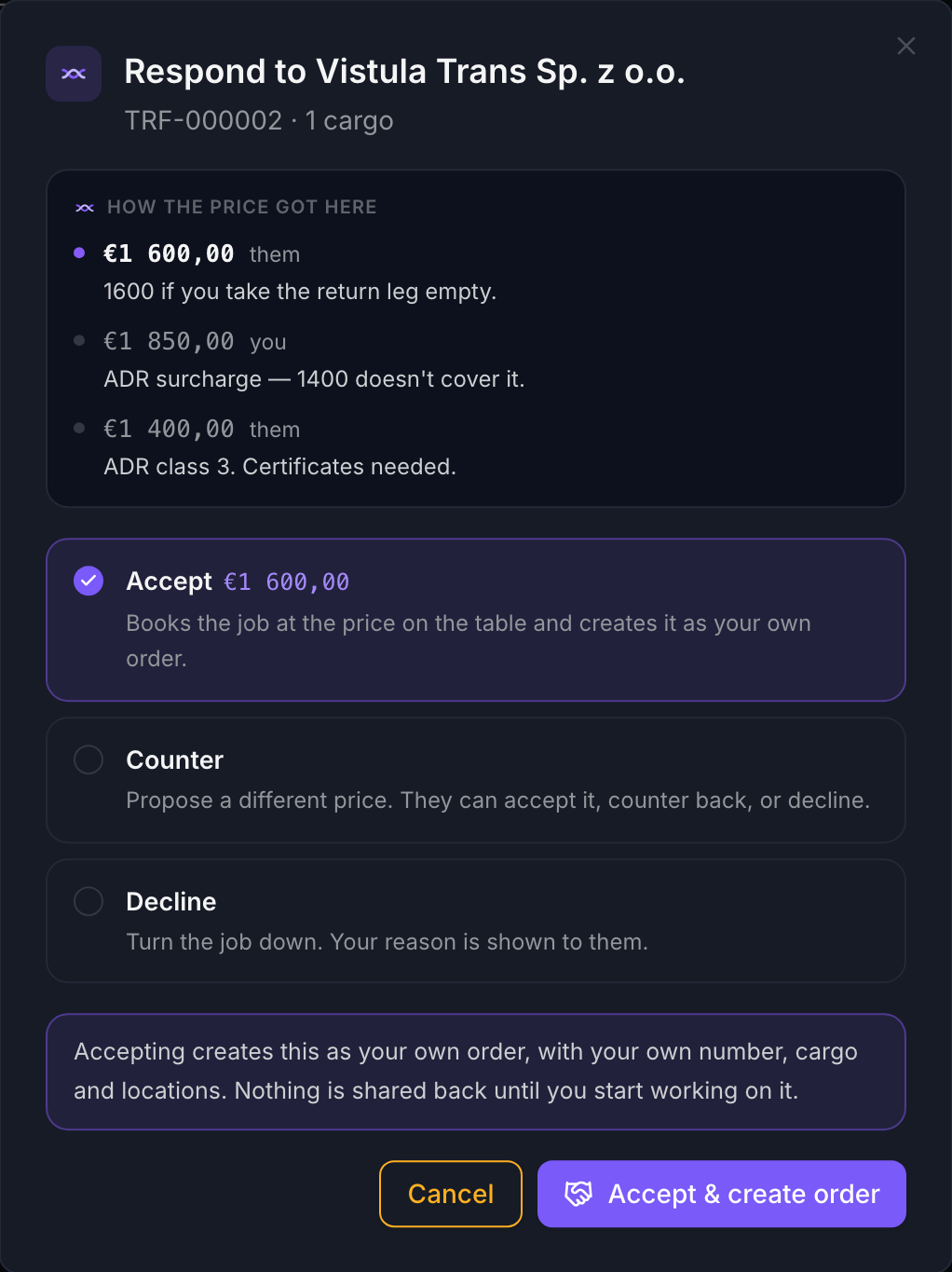
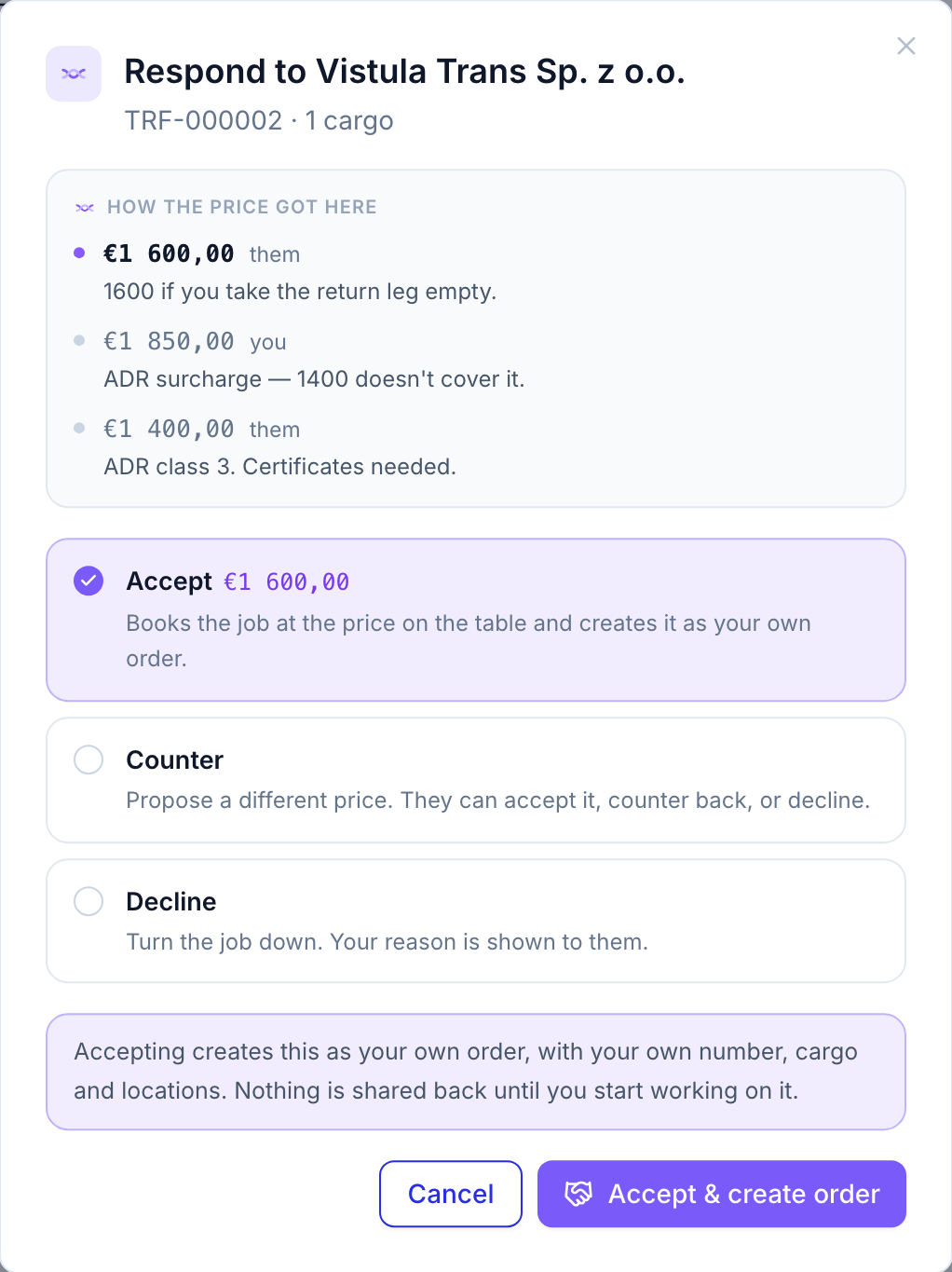
Accepting commits your company, so every answer asks first: the confirm shows the route, the cargo and the price you are agreeing to. Countering sends your price with a reason the partner reads. Declining hands the trip back so it can be placed again.
04 · How freight subcontracting works on Logis
Each step is a card in the thread, on both sides, with the facts open.
Step 1
Offer the load
Pick a connected partner, set the price, and send the carriage with its route, cargo and stop windows.
Step 2
The partner answers
Accept, counter with a reason, or decline — from their Logis inbox or from an email link.
Step 3
The price is agreed
Accepting fixes the terms on the record. From then on the price moves only by a proposal the other side accepts.
Step 4
The trip runs as one record
Their driver’s status changes and the documents they share reach your trip. Your customer sees your company, never the partner.
Step 5
Invoice your customer
Delivered on their side means delivered on yours, and your invoice to your customer is built from the same cargo.
05 · What the network hands you unasked
Because both sides of a handoff run on one record, the network can tell you things you used to ring around for. These are on the roadmap, and marked so.
Who should take this Soon
A carriage with no carrier — partners ranked for the lane from history and answer time.
Return-leg matching Soon
The truck comes back empty; loads along the way home are suggested in the carriage’s own thread.
Live ETA, no phone call Soon
The partner’s driver app feeds your order while it runs your load — this trip only.
Document autopilot Soon
Proof of delivery lands, delivery is confirmed, your sales invoice is drafted, theirs is expected.
06 · The other side
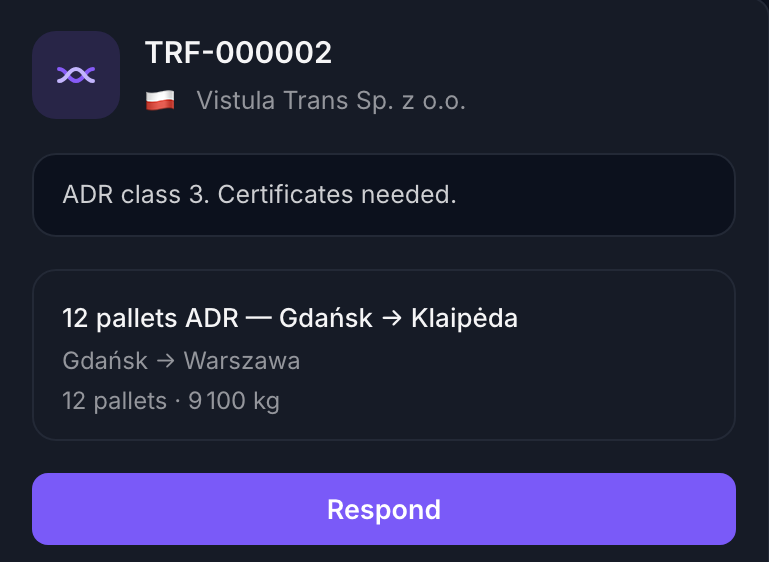
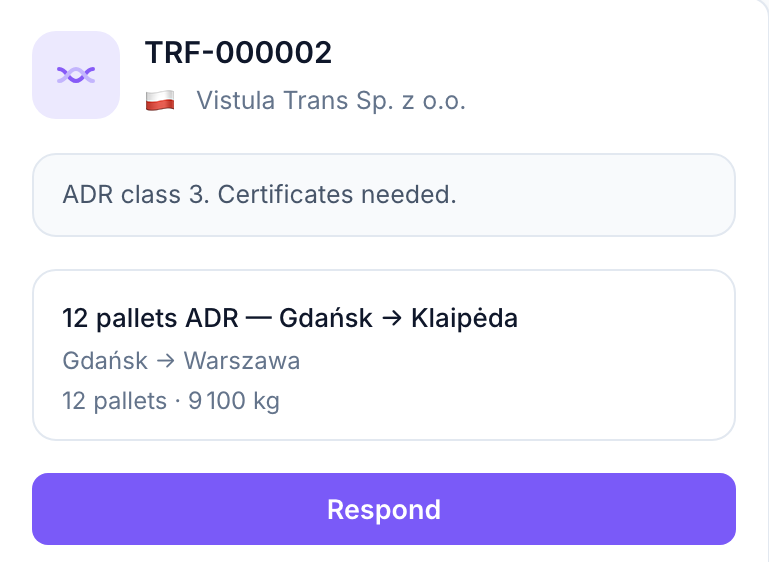
A carrier receiving your handoff sees the request with the three answers on it, in their own language. A partner who is not on Logis gets an email with a link and can answer it without an account.
Sent by email · Sauluva is not on Logis yet
They can answer from the link without an account
07 · Compared
What changes when the handoff is a shared record instead of a conversation.
Questions
Short answers, written to be quoted.
Nordfrakt · Network partner
Messages to Nordfrakt, status changes, documents you share
Your internal messages, your customer price, your other partners
Offer to the next partner automatically after a time you set
Recalled by you
Withdrawn before it starts — not a refusal
Partner asks to cancelNeeds a decision
The job stands until you answer; agree and the trip is yours again
Returned
Handed back to you, to place again
Plan change proposed
Dates, places or cargo amended — accept or decline
Price change proposed
Lines and a reason; nothing changes until the other side accepts
Informed
Sent as information · nobody owes an answer
Declined
Their reason, and the trip back in your hands
Partner’s trip running late
The delay wins the colour; the network chip says whose truck it is
Disruption radar Soon
A ferry cancels; every affected order flags itself and each counterparty can be told in one tap.
Monday digest Soon
The weekly partner call as a card: what ran, what is stuck, the one decision needed.
Fig. 5 · Left: the incoming handoff in the partner’s inbox. Right: the same handoff sent by email to a carrier not yet on Logis.
| Your time |
| Subscription plus fees |
Who you offer to
The agreed price
While the trip runs
What the partner sees
What your customer sees
Cost